📝 Detailed information
🏢 About the local organisation
The history of Open Houses dates back to the mid-1980s, when a group of young people began to restore actual disused village churches. The focus lies on restoration and public use of historical monuments, which allows a long-lasting and effective recovery of the buildings. Currently Open Houses has several historic buildings in its care. All of them are attractive ensembles which display centuries of history. But most of them stood vacant for a very long time and suffered serious structural damage.
In accordance to the above-described focus on heritage, European Heritage Volunteers, a branch of Open Houses, organises Heritage Volunteers Projects, some of them in the framework of the World Heritage Volunteers initiative. European Heritage Volunteers has been active in heritage-related volunteering for more than twenty years. Its objective is to establish links between the fields of heritage and volunteering by continuously working to foster a deeper understanding of heritage and volunteering among those active in either field, and by linking the two fields through practical hands-on projects and educational activities.
💼 What the programme involves
The project consists of two parts – a practical working part which will last 6 hours per day and a study part, which takes place in the evenings and during weekends.
the European Heritage Training Course will be focusing on the documentation and conservation of the remaining ruins of the Baroque synagogue which was destroyed in 1938 and on the recently discovered mikveh.
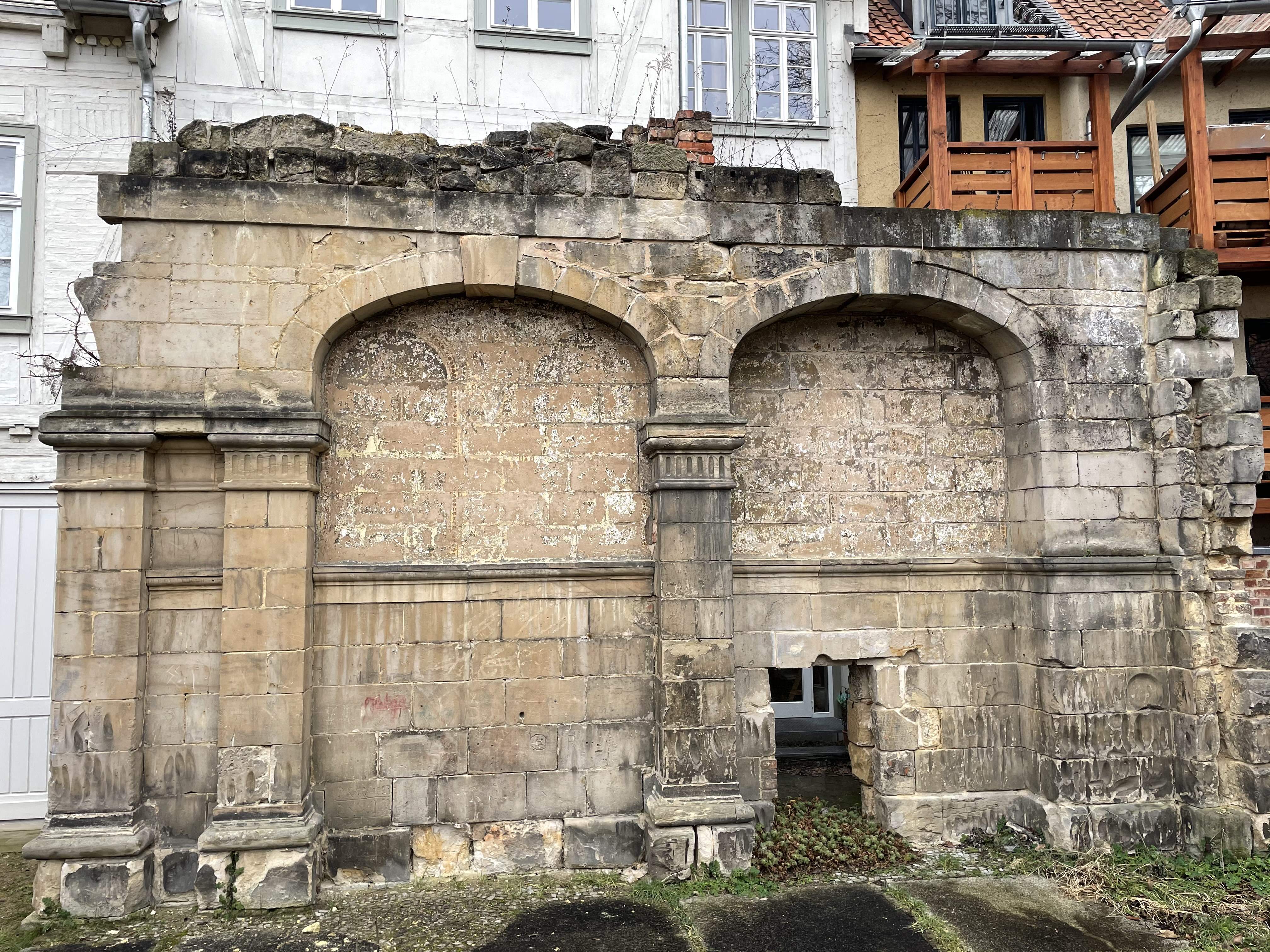
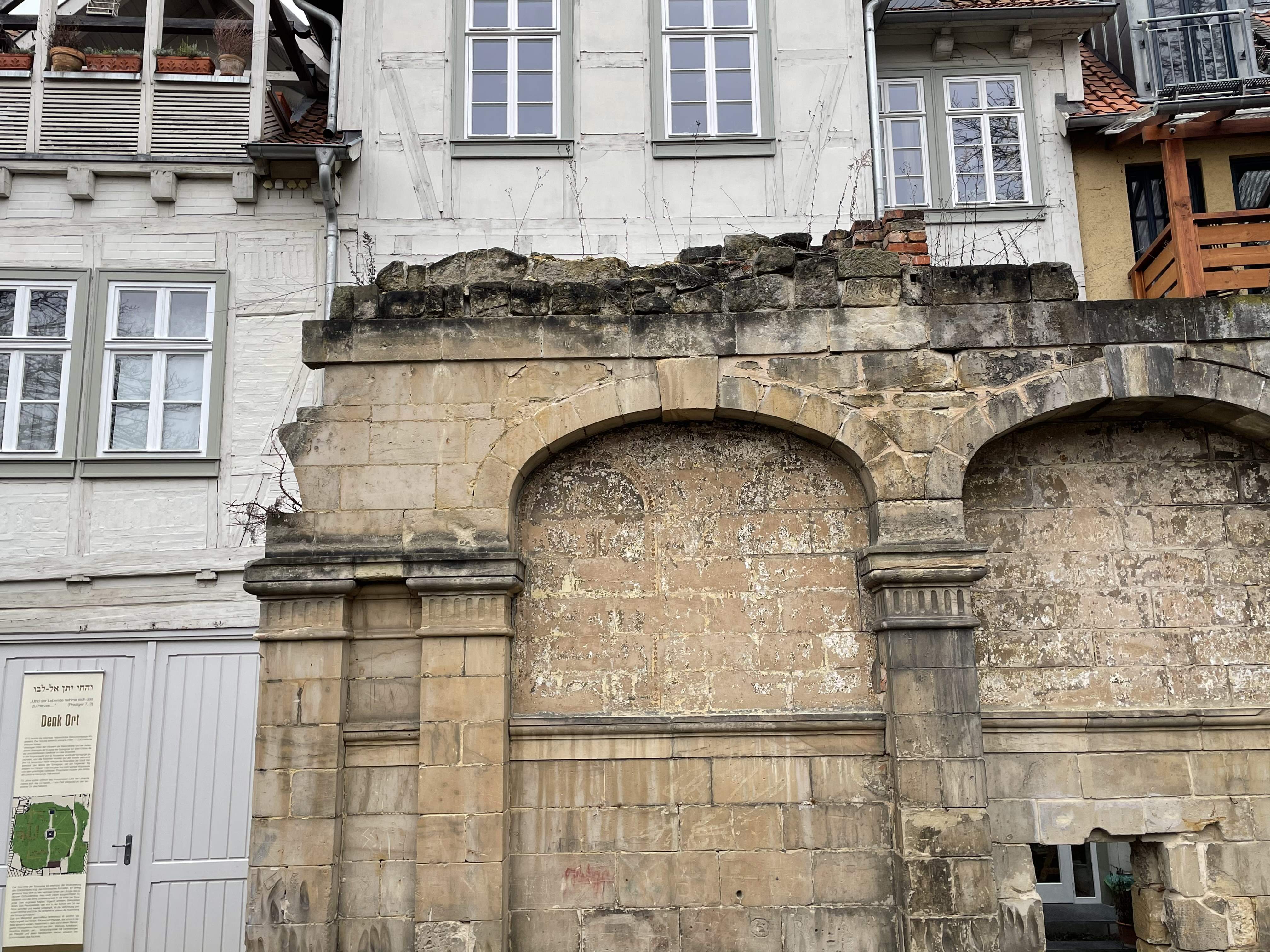
The main focus of the Training Course will lie on conservation interventions at the remaining outer wall of the entrance hall of the former synagogue. After having removed vegetation which could potentially continue to harm the stability of the construction, a detailed documentation of the wall as it stands will be carried out. Afterwards, the loose stones at the upper part of the wall will be re-set in place, the cracks will be closed and the untightened parts of the plaster will be fixed again onto the wall. The interventions will include the preparation of the needed mortars and plasters in accordance to the historically used ones so that the participants will be taught the complete process of fixation, conservation, preparation and restoration of historic plasters. This part of the Training Course will be led by a conservator-restorer with long-years of specialisation in the restoration of wall paintings, stucco and plaster.
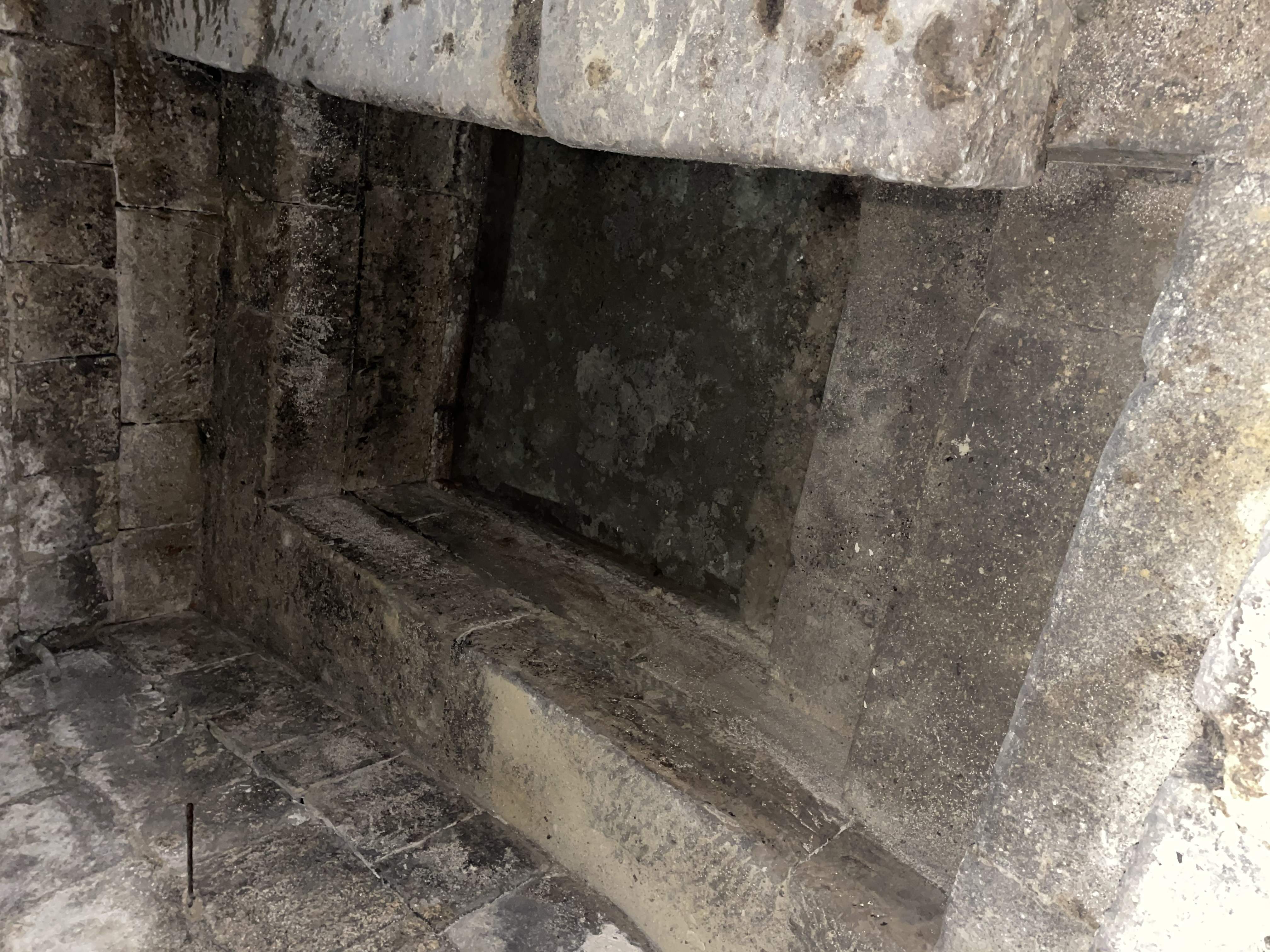
In parallel, the detailed documentation of heritage sites including the documentation of their state of conservation will be practised. Beside the mentioned documentation of the plasters at the remaining outer wall of entrance hall of the former synagogue, this part of the Training Course will also include a detailed documentation of the layers of paints and the ornaments which are still visible on this wall in order to lay the documentary grounds for their future conservation and restoration. Additionally, the documentation will be extended to the other remnants of the synagogue in order to accomplish a complete overview of the existing historical ruins. Finally, a thorough documentation of the mikveh found on Bakenstraíe 56 will be undertaken, which will assist in the interpretation process of the mikveh as a part of the Jewish history of Halberstadt. This part of the Training Course will be led by an architect with additional education in heritage.
🏠 Accommodation on site
All costs linked to the project are covered, including food, accommodation, insurance and transportation during the stay at the project. Travel costs to and from the camp place are not covered. Participants should organise their journey to and from the project place by themselves and on their own expenses. Furthermore, participants should bring their own pocket money.
ACCOMMODATION
In most of the Heritage Volunteers Projects the accommodation is located in a certain distance to the working site. The accommodation is usually very simple; there are shared rooms with simple beds or mattresses at most of the places. Shower, toilet and kitchen are at the place, but sometimes not in the same building. The equipment is simple but fair. After work, when everybody wants to take a shower, there can be a limit of hot water.
FOOD
The meals will be prepared together as they are part of the community life, what means that every participant will be responsible for the meal at least once during its stay.
📍 About the location
Situated at the foot of the Harz Mountains Halberstadt is a town adorned by beautiful religious architecture and traditional timber constructions. It is also well known as being the seat of a historical Jewish community which had an important role in moulding a distinct Jewish culture in Germany.
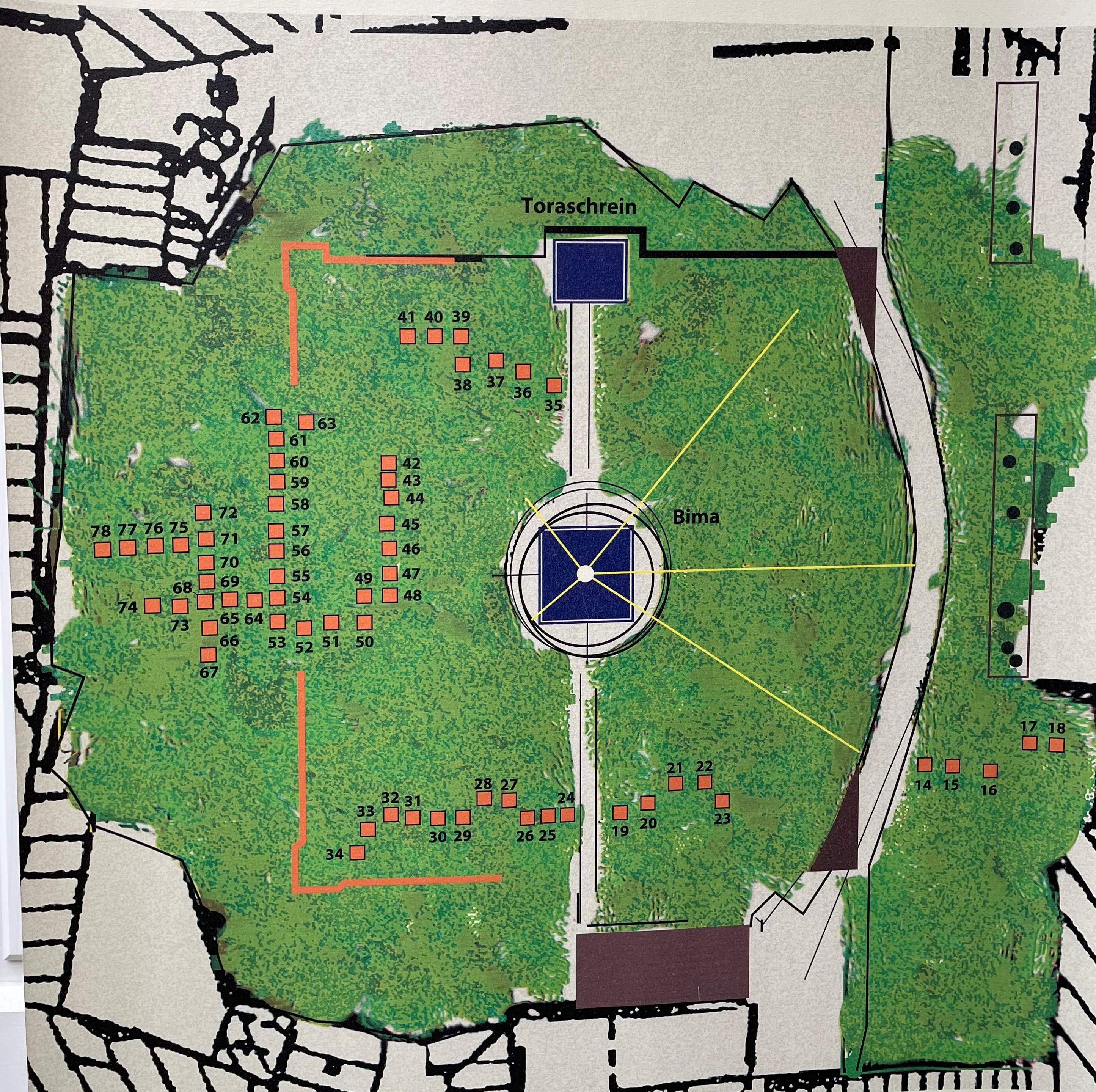
In 1712, a splendid Baroque synagogue, built by the Court Jew Berend Lehmann, was inaugurated. Hidden from view behind the buildings of the streets Bakenstraße and Judenstraße, the cupola of the synagogue surmounted the height of those buildings twice. The synagogue building was the first one in Germany built following a defined architectural concept. At the end of the 19th century, the entrepreneurial Hirsch family decided to invest in the modernisation of the building, extending it by erecting an entrance hall. During the “Night of Broken Glass” – the Pogrom Night – on November, 9th, 1938, the synagogue was plundered, and all Torah scrolls were burnt in the street. On November, 18th the building inspection ordered the demolition of the synagogue. The Jewish community of Halberstadt had to bear costs of the demolition. The only remaining wall which still stands till today is the outer wall of the entrance hall. Of the rest of the structure, only the foundations and the flouring remain; not a single object from the splendid interior is preserved.
The building complex where the ruins are located is nowadays housing the Moses Mendelssohn Academy with the Berend Lehman Museum. Following its traditional purpose, the ensemble became a seat of study and science again in 1998, a place of encounter and exchange for Judaic knowledge. The area where the synagogue had been formerly located is now a place of remembrance, where an art installation by Olaf Wegewitz stands as a reminder of the destroyed place of prayer.
To access the remaining walls of the synagogue one has to pass through the gateway of the former Cantor’s House in Bakenstraße 56, where a traditional mikveh, a Jewish ritual bath, has been uncovered on its basement. Translated from the Hebrew, mikveh means "accumulation of water". A mikveh was used to purify people or religious objects through a ritualistic bath before partaking in religious activities such as the Sabbath, before important festivities or to prepare people before or after yearly cycles.
⚠️ Requirements
Motivation letter related to the project
and CV + photo required
Interview of candidate prior to acceptance via Skype
ℹ️ Additional information
Motivation letter related to the project
and CV + photo required
Interview of candidate prior to acceptance via Skype