📝 Detailed information
🏢 About the local organisation
The history of Open Houses dates back to the mid-1980s, when a group of young people began to restore actual disused village churches. The focus lies on restoration and public use of historical monuments, which allows a long-lasting and effective recovery of the buildings. Currently Open Houses has several historic buildings in its care. All of them are attractive ensembles which display centuries of history. But most of them stood vacant for a very long time and suffered serious structural damage.
In accordance to the above-described focus on heritage, European Heritage Volunteers, a branch of Open Houses, organises Heritage Volunteers Projects, some of them in the framework of the World Heritage Volunteers initiative. European Heritage Volunteers has been active in heritage-related volunteering for more than twenty years. Its objective is to establish links between the fields of heritage and volunteering by continuously working to foster a deeper understanding of heritage and volunteering among those active in either field, and by linking the two fields through practical hands-on projects and educational activities.
💼 What the programme involves
The project consists of two parts – a practical working part which will last 6 hours per day and a study part, which takes place in the evenings and during weekends.
The working part will take place at the so called "kitchen garden", situated at the southern edge of Belvedere Park. The kitchen garden had been arranged in the 19th century as a combined fruit, vegetable and flower garden. Time has had its hand on this garden, and some of its elements have been lost to nature\'s way. Nonetheless, the traces of the original designs remain.
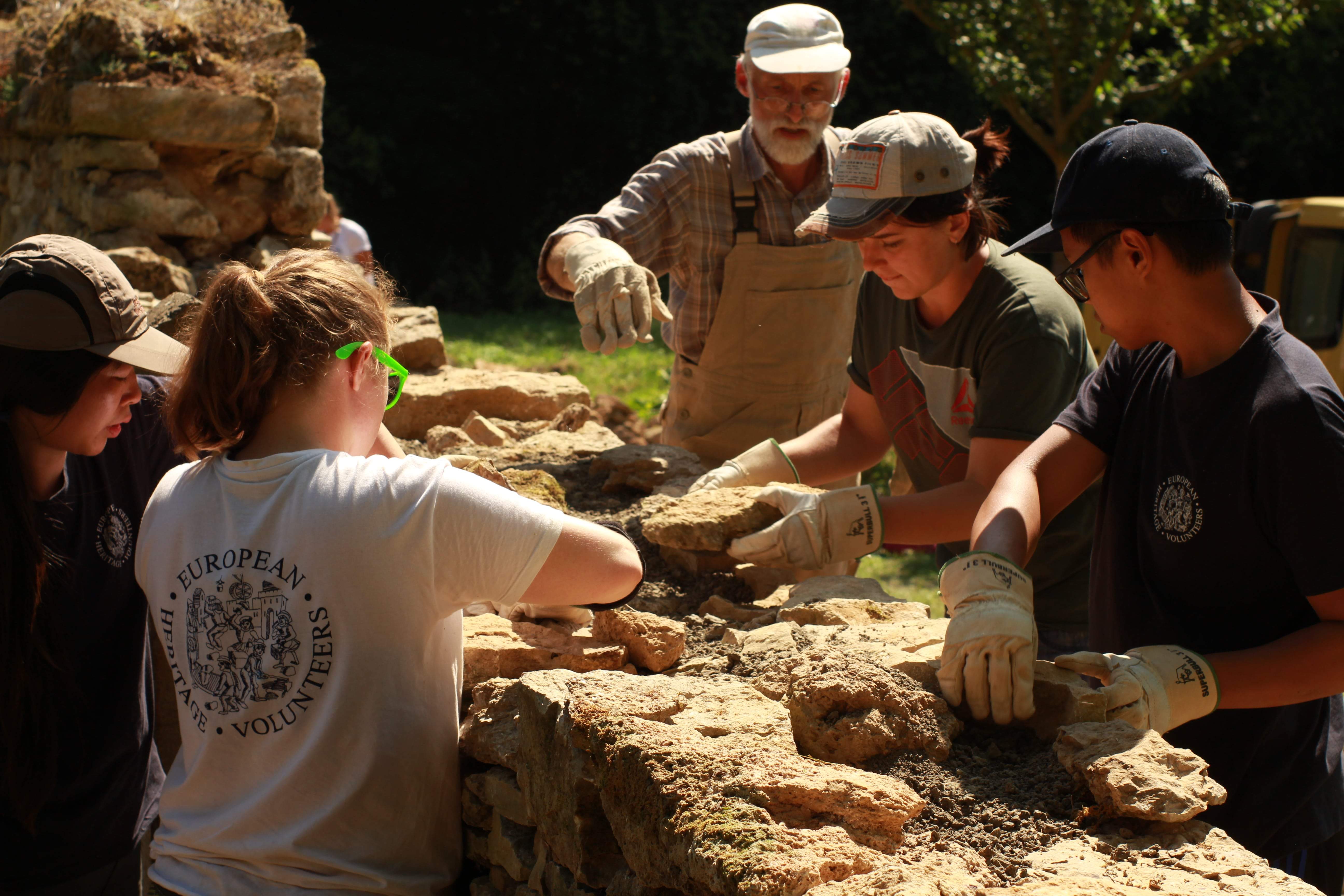
The dry-stone walls as the formative element of the kitchen garden are ruinous and need to be protected against progressive decay. During the previous years the structure has being successively repaired. Within the framework of the 2018 project the first steps have been undertaken, which were advanced in 2019 and 2020; in 2021 the works will be continued. Plants that damage the walls will be carefully taken away, the instable parts of the walls stone by stone deconstructed and later replaced. Since the dry-stone walls are an important habitat for wild bees and other rare insects the interventions need to be carried out extremely carefully. The works will be guided by a bricklayer specialised on dry stone walls and traditional masonry techniques, who will provide during the study part additional theoretical knowledge in this field. Another part of the group will continue to reconstruct a stone stairway connecting the kitchen garden with the other parts of Belvedere Park as well as to uncover and reconstruct the pathway which had been leading to the central area of the kitchen garden, where a small fountain used to be located according to historical records. Eventually, the pathway will be uncovered all the way until the dry-stone wall to complete the narrative of this area of the site. The participants will have the opportunity to rotate between both groups and thus to become familiar both with the dry-stone wall techniques as well as with the tasks related to garden archaeology and the reconstruction of the path system.
The educational part of the project will inform the participants about the background of the project, while providing knowledge about historical gardens and parks, traditional gardening and other related topics. Guided tours will also be included, presenting the participants with an overview of the “Classical Weimar“ as a UNESCO World Heritage site, as well as excursions to related heritage sites. The opportunity of free entrance to museums and exhibitions will also enable in addition individual study.
🏠 Accommodation on site
All costs linked to the project are covered, including food, accommodation, insurance and transportation during the stay at the project. Travel costs to and from the camp place are not covered. Participants should organise their journey to and from the project place by themselves and on their own expenses. Furthermore, participants should bring their own pocket money.
ACCOMMODATION
In most of the Heritage Volunteers Projects the accommodation is located in a certain distance to the working site. The accommodation is usually very simple; there are shared rooms with simple beds or mattresses at most of the places. Shower, toilet and kitchen are at the place, but sometimes not in the same building. The equipment is simple but fair. After work, when everybody wants to take a shower, there can be a limit of hot water.
FOOD
The meals will be prepared together as they are part of the community life, what means that every participant will be responsible for the meal at least once during its stay.
📍 About the location
In the late 18th and early 19th centuries the small town of Weimar in Thuringia saw a remarkable cultural flowering. Enlightened ducal patronage attracted many leading German writers, composers and artists to the town, including Johann Wolfgang von Goethe, Friedrich Schiller and Franz Liszt, thus making Weimar the cultural centre of Europe at that time. This development is reflected in the high quality of many of the buildings and parks in the surrounding area.
“Classical Weimar” was added to the list of UNESCO World Heritage Sites in 1998, the 20th site in Germany to be recognised as World Heritage. “Classical Weimar” comprises twelve individual buildings and ensembles, all of which portray tangible and intangible elements of Classical Weimar’s cultural heritage. Weimar’s City Castle, the Duchess Anna Amalia Library, Goethe’s and Schiller’s residences, the Town Church, the Ducal Vault with the Historic Cemetery and many others are included on the World Heritage List.
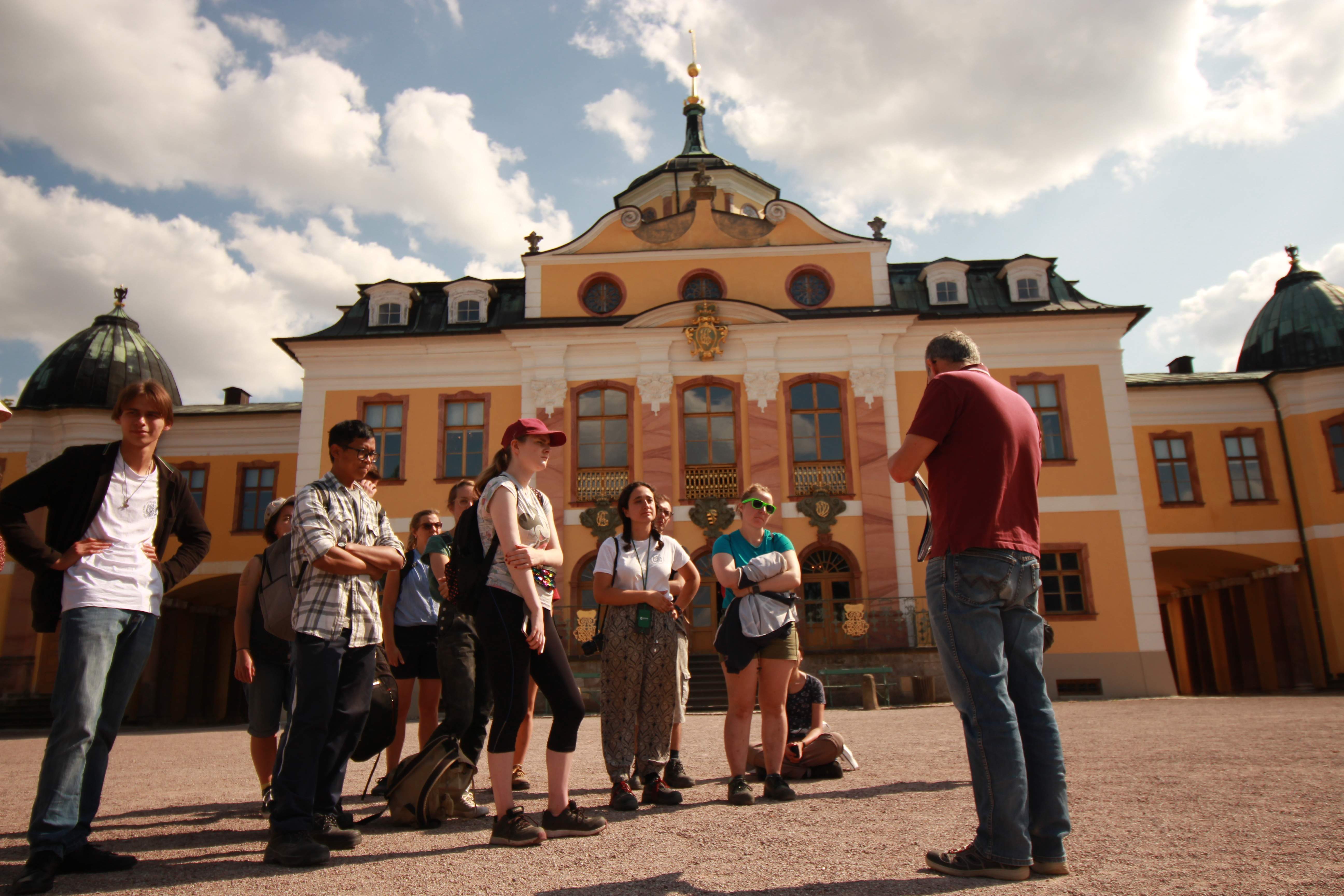
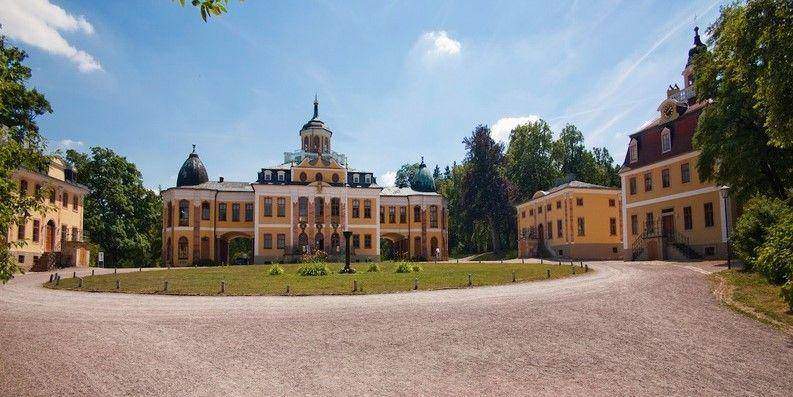
Weimar’s historical parks and gardens connect the historical buildings and their surrounding grounds and are a key feature in the “Classical Weimar” collection: The Park on the Ilm with the Roman House and Goethe’s Garden House, Belvedere Park with its Castle and Orangery, Tiefurt Park and Castle and Ettersburg Park and Castle.
The European Heritage Volunteers Project “Parks and Gardens of Classical Weimar” has been taking place since 2011. As in all years since 2012, also the 2021 project will be carried out within the framework of the UNESCO World Heritage Volunteers Initiative. It is to this year the longest ongoing project under the framework of the WHV Initiative that has been in function uninterruptedly.
⚠️ Requirements
Motivation letter related to the project
and CV + photo required
Interview of candidate prior to acceptance via Skype
ℹ️ Additional information
Motivation letter related to the project
and CV + photo required
Interview of candidate prior to acceptance via Skype